China’s Overall Energy Balance
10 min read
China has undergone dramatic changes since the 1980s. From a closed and failing communist economy, the country has opened up to globalization, taking on a major place in trade with all regions of the world and becoming an economic and geopolitical “superpower”. This transformation has seen a surge in demand for energy – a trend not likely to change any time soon.

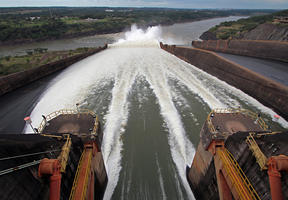
© STR / AFP - Hydropower is one of the strong points in China’s energy mix. The country is continuing to add new facilities. Pictured here is the construction of a dam at the Baihetan site in Yunnan Province (southwest China).
Maintaining Growth, Reducing CO2 Emissions
China’s must meet two contradictory requirements: ensure that growth, even if slowing, remains higher than that of other major countries, and reduce emissions to comply with international climate agreements.
After growth rates of 3% at the time of the Covid-19 crisis, China's growth was 5% in 2024, compared with 2.8% in the United States and 1% in the European Union. This means that energy consumption will undoubtedly continue at an annual rate of at least 3%.
At the same time, China has set ambitious climate targets for the first time. It now aims to “peak” its emissions before 2030 and to become carbon neutral by 2060 (Europe has committed to do the same by 2050).
Coal’s Continued Dominance
China continues to build coal-fired power plants and announced a new program in 2024. Chinese authorities have argued that they are essential to support grid stability in the face of rapidly expanding intermittent sources.
was decisive in China's great economic leap forward. It is a resource based on coal, a resource the country has in abundance. Not only does China produce the most coal worldwide (it holds the second-largest coal reserves after the United States), it imports more than any other country too, including India. The proportion of coal used in generation is over 60%, compared with 1.8% in France and 30% in the United States.
The new power plants are, however, smaller, more efficient, and... further away from cities to reduce pollution that has become dangerous to the health of city dwellers.
According to the , this strategy reflects a desire to secure energy supplies, but it raises questions about its compatibility with global climate goals, particularly those set out in the Paris Agreement. The IEA stresses that continued investment in coal could make it more difficult to achieve carbon neutrality.
Renewable Energies are booming
China's willingness to use renewable energy cannot be doubted. In 2024, China installed more solar capacity than the rest of the world combined.
The sheer size of the country and its huge industrial capacity allow China to develop immense solar and wind farms. By the end of 2024, these two renewable energies accounted for 26% of China's electricity production, a level never before achieved (13.6% for wind power and 12.4% for solar power). China also boasts the largest hydroelectric capacity in the world, symbolized by the giant Three Gorges hydroelectric power station on the Yangtze River, which came on stream between 2006 and 2009. Its capacity is estimated at 22,500 megawatts. (By comparison, the largest French plant, Grand’Maison, has a capacity of 1,800 megawatts).
Securing Oil and Gas Supplies
China is not a major oil and gas producer. But it has become the world’s leading oil importer. While gas currently makes up just over 5% of the country’s total consumption, its imports are accelerating, and China has become a major player in the global market.
Such oil and gas dependency has a strong influence on geopolitics. China is strengthening its military fleet and investing in many of the world’s economic hubs. It is also building numerous land and sea transportation links with Africa, the Middle East and Europe (the “New Silk Roads”) to secure its supplies while further developing markets for its products.
Russia, deprived of its markets in Europe due to the war in Ukraine, would like to build a new pipeline across Siberia. But China is keen to diversify its suppliers, particularly in the Gulf and Central Asia.
Nuclear Power Continues to Grow
With an of 55 GW, China had the third largest nuclear fleet in the world at the end of 2024, behind the United States (97 GW) and France (63 GW including the new EPR reactor). But it is set to move into second place soon, as it has begun construction on an additional 30 GW.
This growth will continue beyond 2025, in a global context that is favorable to the development of nuclear power.
 Geopolitics of energy
See all